Part-time CFO vs bookkeeper: which saves runway and scales ARR?
Understanding part-time cfo vs bookkeeper is the single most practical decision a founder or CEO can make to align finance capability with growth stage. At a glance: a bookkeeper records historical transactions, enforces day-to-day accounting accuracy, and produces the ledgers and reconciliations that keep the business legal and operational; a part-time CFO elevates finance to a strategic function — translating those ledgers into cash-flow strategy, capital plans, investor-ready models, and board-grade reporting that materially change outcomes like runway, fundraising success, and margin improvement.
This article unpacks the functional differences, the business problems each role solves, the systems and outputs you should expect, hiring and cost trade-offs, and an implementation playbook that CEOs and founders can use to decide, hire, and measure impact. part time cfo for small businesses synthesizes best practices from finance leadership work, professional accounting standards, and investor expectations so the next steps you take reduce execution risk and increase optionality.
Transition: First, clarify the core responsibilities and deliverables of each role so expectations line up with business needs.
Core responsibilities and deliverables: what bookkeepers and part-time CFOs actually do
Bookkeepers and part-time CFOs both sit on the finance ladder but they operate at different rungs. Engineers of record vs architects of strategy is a useful metaphor: bookkeepers construct the accurate record that enables everything downstream; part-time CFOs use that record to make high-leverage decisions and translate finance into a business roadmap.
Bookkeeper: the foundation — day-to-day accuracy and compliance
A professional bookkeeper focuses on transaction-level accuracy and maintaining accounting systems so internal teams and external stakeholders can trust the numbers. Typical responsibilities include:
- Recording all transactions in the general ledger, classifying revenues and expenses per accounting policies and the chart of accounts.
- Reconciling bank and credit card accounts, merchant processors, payroll clearing accounts, and vendor statements to ensure balance-sheet integrity.
- Managing accounts payable and receivable workflows; issuing invoices, posting payments, and aging receivables to maintain collections discipline.
- Processing payroll and related tax filings (or preparing payroll inputs for third-party providers).
- Preparing routine reports: trial balance, cashbook, profit and loss on a nominal basis, and periodic journals such as depreciation or accruals.
- Supporting tax preparers and external accountants with clean source data at year-end or during audits.
Primary deliverables: up-to-date general ledger, reconciled bank accounts, clean-month-end close packages, and transactional controls. The bookkeeper’s work reduces financial risk and prepares the business for accurate reporting and advisory analysis.
Part-time CFO: strategy, forecasting, and investor readiness
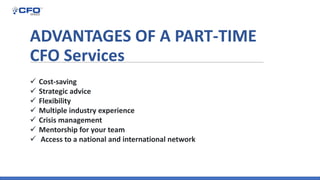
A part-time CFO (also called a fractional or outsourced CFO) adds strategic finance capability without the overhead of a full-time hire. The role blends technical finance skills with business strategy and the ability to communicate with investors and boards. Typical responsibilities include:
- Designing and owning the forecast and rolling cash model that connects operating levers to runway and capital needs.
- Defining and tracking company-level KPI frameworks and unit economics to guide pricing, acquisition spend, and margin improvement.
- Leading fundraising preparation — building investor-ready financial models, valuation scenarios, and due diligence packs.
- Conducting scenario planning and sensitivity analysis to quantify downside risk and capital efficiency improvements.
- Implementing finance policies, internal controls, and month-end governance to scale operations and reduce fraud or leakage.
- Advising on capital structure, debt vs equity decisions, and negotiating with investors, banks, or acquirers.
Primary deliverables: a robust rolling cash flow model, KPI dashboards, board-level reports, fundraising materials and a prioritized roadmap of finance initiatives that increase enterprise value.
Overlap and handoffs: how the two roles collaborate
Where the roles intersect, clarity and process design prevent duplication and gaps. Bookkeepers provide the raw material; the part-time CFO consumes it for forward-looking analysis. Practical handoffs include:
- Daily/weekly transaction quality from the bookkeeper enabling accurate weekly cash snapshots for the CFO.
- Month-end close package from the bookkeeper (trial balance, aged receivables/payables, recon reports) feeding the CFO’s variance analysis and board pack.
- Control loops: bookkeeper manages segregation of duties and routine reconciliations; CFO designs and audits those controls periodically.
Decision rule: if your need is legal/operational accuracy, hire or keep a bookkeeper; if your need is runway extension, capital raise, efficiency or strategic pricing, you need a part-time CFO.
Transition: With role clarity established, examine the concrete business problems each role solves and the measurable benefits CEOs and founders should expect.
Business problems solved: connecting finance work to outcomes CEOs care about
CEOs, founders, and growth owners prioritize predictable cash, investor readiness, profit pathways, and manageable burn. Each finance role directly influences these outcomes in different ways. This section maps problems to remedies and expected results.
Cash flow visibility and working capital optimization
Problem: Founders often misjudge runway because cash and accrual reports diverge or because collections and payables aren’t actively managed.
Bookkeepers provide daily transaction visibility and ensure bank reconciliations are accurate — the prerequisite for trustworthy cash positions. A part-time CFO converts that accuracy into a forward-looking cash runway model, implementing policies like days sales outstanding (DSO) targets, supplier payment scheduling, and short-term financing strategies.
Result: stronger cash visibility reduces the probability of surprise liquidity shortfalls, lowers emergency financing costs, and gives the CEO time to execute strategic alternatives rather than firefighting collections or payroll.
Faster and more successful fundraising
Problem: Fundraising stalls when models are poorly constructed, assumptions aren’t defensible, or the books don’t reconcile during due diligence.
A part-time CFO prepares investor-ready financial models, stress-tests scenarios, and compiles due-diligence-ready packs. This includes standardized cap table summaries, historical reconciliations, contracts schedules, and clean audited or reviewed financial statements as needed.
Result: shorter diligence timelines, higher credibility with investors, better term negotiation leverage, and reduced burn from prolonged fundraising cycles.
Lower burn-rate risk and clearer path to profitability
Problem: Many high-growth companies confuse revenue growth with unit-level profitability; without disciplined metrics, scaling increases risk of accelerating losses.
Part-time CFOs dig into unit economics — gross margin, contribution margin, CAC payback — and redesign cost structures or pricing to improve leverage. They prioritize high-impact levers such as pricing tests, channel mix shifts, and resource allocation adjustments informed by sensitivity analysis.
Result: improved margin profile, predictable break-even timelines, and actionable plans that reduce runway consumption while preserving growth optionality.
Compliance, controls, and audit readiness
Problem: Weak controls create tax exposure, misstatements, and risk during capital events or exits.
Bookkeepers maintain transaction trails and filings; part-time CFOs design the control environment, implement segregation of duties, and prepare for external audits or reviews. Their work aligns with standards like GAAP and industry-specific regulations and often reduces the cost and timeline of formal audits.
Result: lower regulatory and legal risk, cleaner audits, and higher buyer/investor confidence during M&A or fundraising.
Strategic decision support and board-level reporting
Problem: CEOs need concise, insightful reporting that connects operations to strategy. Raw ledgers don’t translate to strategic choices.
Part-time CFOs produce board packs, scenario memos, and KPI dashboards that concisely answer “what would happen if we...?” for key strategic options. They also translate finance into language that non-financial executives and board members use to make decisions.
Result: faster, higher-quality strategic decisions, aligned leadership priorities, and better governance with measurable KPI commitments.
Transition: To deliver these outcomes, the people you hire need specific skills, tools, and outputs — next we’ll outline those requirements and the practical technology stack.
Skills, tools, and outputs: the technical anatomy of effective finance work
Match the problem to the capability. High-impact finance work requires domain knowledge and a practical toolset. CEOs should evaluate candidates and vendors by their ability to deliver specific outputs using credible systems.
Core skills and experience to look for
Bookkeepers should demonstrate: strong transactional accounting, familiarity with bookkeeping platforms (QuickBooks, Xero), bank reconciliation proficiency, payroll processing experience, and a track record of clean month-ends. Certifications like AIPB or experience working under CPA oversight are helpful.
Part-time CFOs should demonstrate: experience building investor-grade financial models, FP&A and scenario planning, fundraising support, pricing and unit-economics optimization, leading finance transformation projects (ERP migrations, chart-of-accounts redesign), and board reporting. Look for senior hires with Big Four audit exposure, startup finance history, or prior CFO/CFO-advisory roles. Comfortable fluency with GAAP and a practical approach to investor metrics is essential.
Systems and technology stack
Minimal stack for reliable finance operations:
- Transactional layer: QuickBooks, Xero, or a cloud ERP (NetSuite) depending on volume and complexity.
- Payroll and benefits: Gusto, ADP, or Paychex for accurate payroll posting and tax compliance.
- Bank and payments: Plaid/connectors and payment processors integrated to reduce manual reconciliations.
- Reporting and planning: Excel for bespoke models initially; integrated planning tools or FP&A platforms (Adaptive Insights, Vena, Planful) as scale requires.
- BI and dashboards: Power BI or Tableau for interactive KPI dashboards; looker or mode for more data-centric teams.
- Cap table and equity: Carta, Pulley, or eShares for clean capitalization data when fundraising or granting equity.
Integration quality is critical: a disconnected stack increases month-end toil and weakens forecast accuracy. Part-time CFOs should prioritize data flows and automation that reduce manual journal entries.
Typical outputs and what they should look like
Bookkeeper outputs: timely bank reconciliations, aged AR/AP reports, trial balance, and transaction-level documentation organized for tax or audit.
Part-time CFO outputs:
- Rolling 13- to 24-month cash flow forecast with scenario toggles and clear assumptions attribution.
- Unit-economics dashboard linking acquisition cost, churn, lifetime value, and margin.
- Monthly board pack with summarized P&L commentary, balance sheet variances, cash outlook, and top three risks/opportunities.
- Fundraising model and sensitivity analysis, including use-of-proceeds schedule and implied valuation scenarios.
- Finance roadmap with prioritized initiatives and expected impact on runway or EBITDA.
Evaluating quality: every output should state assumptions, model sensitivity, source of truth (ledgers), and the next action item tied to a business decision.
Transition: Capability and tools influence cost and ROI. The next section helps decide the right hiring model and how to measure value.
Hiring models, pricing, and calculating ROI
Choosing between a bookkeeper, a part-time CFO, or both requires balancing cost, timing, and the financial return of the work. Under-investing in finance delays growth; over-investing wastes cash. The right model is stage-dependent.
Hiring models explained
- In-house bookkeeper: full-time or part-time employee managing day-to-day accounting. Best for steady transactional volume and when you need control over cash operations.
- Outsourced bookkeeping firm: a cost-effective option for reliable transaction processing with predictable SLAs. Often used by small businesses wanting scalability without hiring.
- Part-time/fractional CFO: retained on a monthly retainer or agreed-hours basis (10–40 hours/month). Delivers strategic outputs without full-time payroll impact.
- Virtual CFO firm: combines bookkeeping, controller services, and CFO advisory through a firm; useful when you need a bundled team and cover for absences.
- Full-time CFO: when finance needs are constant and complex — e.g., sustained growth with multiple product lines, regulatory complexities, or imminent IPO/M&A.
Pricing benchmarks (broad guidelines)
Bookkeeping:
- Simple small business: $300–$1,000/month for basic bookkeeping (fewer transactions, single entity).
- Growing SMB: $1,000–$5,000/month when payroll, multiple entities, and AP/AR complexity increase.
Part-time CFO:
- Fractional CFOs typically charge $2,500–$10,000/month depending on hours, deliverables, and experience level. Hourly rates $150–$500+/hr depending on location and seniority.
- Virtual CFO firms may offer tiered retainers where strategic deliverables are bundled with a higher monthly fee but more consistent coverage.
Choose pricing aligned to deliverables (e.g., fundraise readiness and rolling cash model should be itemized). Avoid open-ended monthly retainers without KPIs.
Calculating ROI and value
Measure ROI in terms of runway extension, avoided cost, and revenue impact. Examples of quantifiable value:
- Shorter fundraising cycle that reduces monthly burn by X months — multiply saved burn by monthly cash consumption to estimate avoided financing costs.
- Improved collections reducing DSO by 10–20 days — calculate incremental cash-on-hand and the reduction in working capital needs.
- Pricing or cost changes that increase gross margin by Y percentage points — project uplift to contribution margin and EBITDA timeline improvement.
- Reduced audit fees and faster close time due to improved controls — lower professional services spend and less executive time diverted.
Decision metric: if a part-time CFO’s expected monthly impact (runway extension, margin improvement, fundraising success probability increase) outweighs the retainer over a planning horizon (6–12 months), hire. For transactional accuracy and compliance, the bookkeeper returns direct cost avoidance and must be in place before advanced CFO work.
Transition: Once hired, successful outcomes require structured onboarding, clear SLAs, and disciplined reporting cadence — the next section gives a practical implementation plan.
Implementation playbook: onboarding, SLAs, and the first 90 days
Execution matters more than titles. A precise onboarding plan and agreed KPIs will determine whether the hire reduces risk or becomes another expense line.
Onboarding checklist for bookkeepers
- Inventory of financial accounts, merchant processors, payroll providers, payroll tax IDs, and existing contracts.
- Access and permissions to accounting software (with multi-factor authentication), bank feeds, and vendor portals.
- Chart of accounts review and clean-up for consistency with reporting needs.
- Define month-end close checklist, deadlines, and owner responsibilities.
- Reconciliation templates, archival policies for receipts and invoices, and a secure document repository for audit trails.
30/60/90 plan for a part-time CFO
Effective fractional CFO engagements are outcome-driven. A pragmatic 30/60/90 plan looks like:
- Days 1–30: stabilize books, validate cash position, review key contracts and cap table, produce a baseline one-page financial summary and risk list.
- Days 31–60: deliver an initial rolling 13-week and 12-month cash forecast, propose immediate cost levers, and set up KPI dashboards. Start fundraising readiness if relevant.
- Days 61–90: implement go-forward processes (forecast cadence, board pack), lead investor conversations or lender engagement if needed, and begin longer-term finance roadmap execution (ERP improvements, margin initiatives).
Deliverables should be explicit at each milestone and tied to measurable outcomes such as runway months, DSO reduction, or investor term sheet progress.
Reporting cadence and SLAs
Set predictable rhythms:
- Daily: cash-balance alert if thresholds breached.
- Weekly: cash flow update and KPI snapshot for the CEO.
- Monthly: full closes, variance analysis, board pack, and operating metrics.
- Quarterly: strategic review, scenario planning, and funding readiness.
Service level agreements should articulate expected response times, deliverables, escalation paths, and metrics to measure the engagement (e.g., forecast accuracy, close efficiency, fundraising milestones achieved).
Transition: strategy is clearer with examples. The following real-world scenarios show when each role is most impactful and the tangible outcomes to expect.
Real-world scenarios: when to hire which role and expected outcomes
Specific business situations help translate abstract capabilities into decisions. Below are common scenarios and recommended configurations.
Early-stage pre-revenue startup
Profile: small team, limited transactions, focus on product-market fit, runway is constrained.
Recommendation: contract a reliable bookkeeper or outsourced bookkeeping service for clean records and basic tax compliance. A part-time CFO is optional until there’s recurring revenue or the team pursues aggressive fundraising beyond friends & family. If fundraising is imminent, bring a part-time CFO for model-building and investor materials.
Expected outcome: clean books for grant applications or accelerators; if a fractional CFO joins, higher-quality pitch decks and defensible models that increase investor confidence.
Growth-stage company scaling ARR (SaaS or subscription)
Profile: recurring revenue, accelerating marketing spend, churn becomes critical, unit economics matter.
Recommendation: hire both — a bookkeeper (or controller) to maintain transactional integrity and a part-time CFO to own KPIs (MRR/ARR, churn, LTV/CAC), run cohort analysis, and design pricing experiments.
Expected outcome: improved CAC payback, clearer path to sustainable growth, and better-informed decisions on sales hiring or marketing allocation.
Distressed business or cash squeeze
Profile: cash is tight, collections lag, need immediate restructuring or bridge funding.
Recommendation: a part-time CFO should be prioritized to stabilize cash, negotiate creditor terms, and present rescuable scenarios to lenders or investors. Bookkeeping should be accurate concurrently to support negotiations and reconcile bank activity.
Expected outcome: emergency cash plan, short-term financing, prioritized headcount or spend cuts, and reduced insolvency risk.
Preparing for M&A or exit
Profile: owner wants to maximize sale value; acquirers conduct rigorous due diligence.
Recommendation: hire a part-time CFO with transaction experience to clean financials, normalize EBITDA, prepare due-diligence packs, and run valuation scenarios. A controller/bookkeeper must ensure historical data reconciles to the books.
Expected outcome: cleaner buyer conversations, higher purchase multiples from visible margin improvements and predictable revenue, and smoother diligence.
Transition: concluding advice helps you move from decision to action with a short diagnostic and pragmatic next steps.
Concise summary and actionable next steps
Decide based on your immediate problem: if your challenge is transactional accuracy, tax compliance, or keeping the lights on operationally, hire a competent bookkeeper immediately. If your challenge is runway, fundraising, pricing, margin expansion, or strategic financial governance, bring in a part-time CFO who can turn clean books into decisions that materially alter outcomes like runway length, fundraising success rate, and path to profitability.
Quick diagnostic checklist

- Do you know your cash runway to within one week? If not, you need a part-time CFO.
- Are month-end books reconciled and auditable? If not, hire a bookkeeper.
- Is fundraising scheduled in the next 3–6 months? If yes, engage a part-time CFO now.
- Are your unit economics and KPIs tracked and trusted? If not, prioritize a part-time CFO with FP&A skills.
Interview questions (shortlist)
- For bookkeepers: how do you handle monthly bank reconciliations, and can you show a recent close checklist? What bookkeeping platform do you prefer and why?
- For part-time CFOs: show a fundraising model you built and explain three assumptions that were most heavily negotiated by investors. How have you extended runway for previous clients?
Contract terms and KPIs to include
- Define deliverables (cash model, board pack, KPI dashboard) and timeline for a part-time CFO; for bookkeepers define SLAs for reconciliations and month-end close.
- Include performance KPIs: forecast accuracy, DSO improvement, reduced close time, or fundraising milestones.
- Set review cadence and exit clauses tied to missed deliverables or material process failures.
Action plan: get your books current first. Simultaneously, ask a fractional CFO to produce a 13-week cash forecast and prioritized 90-day plan. Measure impact weekly and tie compensation to clear milestones such as runway extension or a funded round. That combination — transactional rigor plus strategic finance — delivers the strongest, fastest path to sustainable growth and investor readiness.